
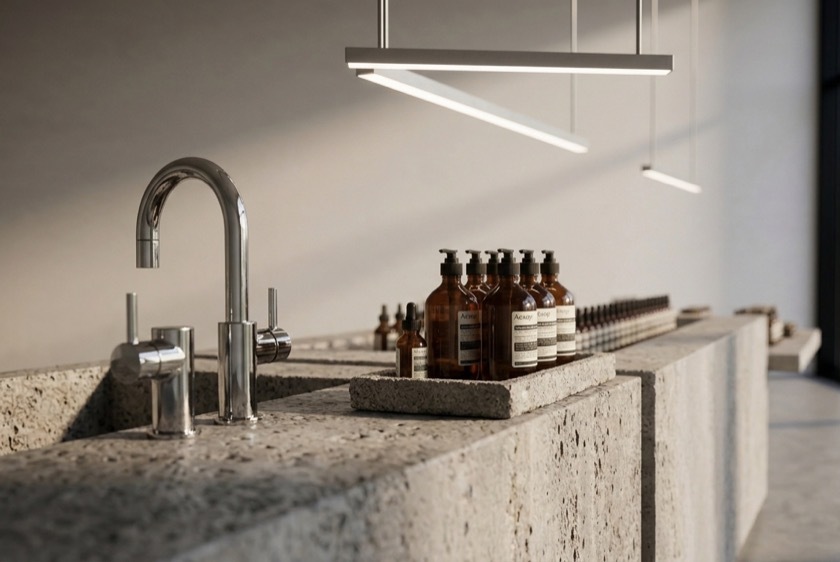
Light is the most powerful and most overlooked material in design. We shape it, layer it, and withhold it, yet unlike stone or timber it can never be touched or held. It arrives, it moves, and it leaves, and in its passing it decides how every other material in the room will feel. A space is not truly finished when the surfaces are chosen. It is finished when the light knows how to move through it.
Because light is a material, so too is its absence. We design the darkness as carefully as the light. A room lit evenly from every direction is a room with nothing to say; it flattens, it exhausts, it gives the eye nowhere to settle. Shadow is what gives a space depth and rhythm. The pool of warmth over a dining table means something only because the corners beyond it are allowed to fall quiet. We treat those quiet corners as part of the composition, not as failures of illumination.
Natural light is the first draft and the truest one. We follow it across the day before we place a single fixture. Morning light comes in low and long, stretching across a floor and warming it slowly. Midday light is high and bright and honest, flattening shadow and revealing the true color of every surface. Evening light turns amber and horizontal, catching the raised grain of timber and the open pores of stone until the whole room glows from the side. To design a home is to choreograph these hours.
Then we build the artificial light in careful layers, and almost never from overhead alone. A single linear fixture can turn a flat wall into a living gradient, a wash of light that fades gently from bright to soft and gives the whole plane a sense of breath. We favor light that grazes a surface rather than striking it head on, because a low, raking beam is what makes texture visible, throwing the smallest ridge of plaster or stone into gentle relief.
The layers matter as much as the sources. There is the ambient light that lets you move through a room without thinking. There is the accent light that draws the eye to a single material or a single object and lets everything around it recede. And there is the deliberate darkness that holds them together. When these layers are balanced, a room stops feeling lit and starts feeling alive, sculpted from within rather than exposed from above.
What we are really designing is a day. The same room should feel like a bright, open workspace in the morning and a low, intimate refuge at night, and the light is what carries it between those two lives. Restraint is the discipline that makes this possible. It is tempting to add another fixture, another bright point, but the calm of a well-lit room usually comes from what we chose to leave dark.
In the end, to design with light is to accept that the most beautiful thing in a room is often the shadow standing quietly beside it.