
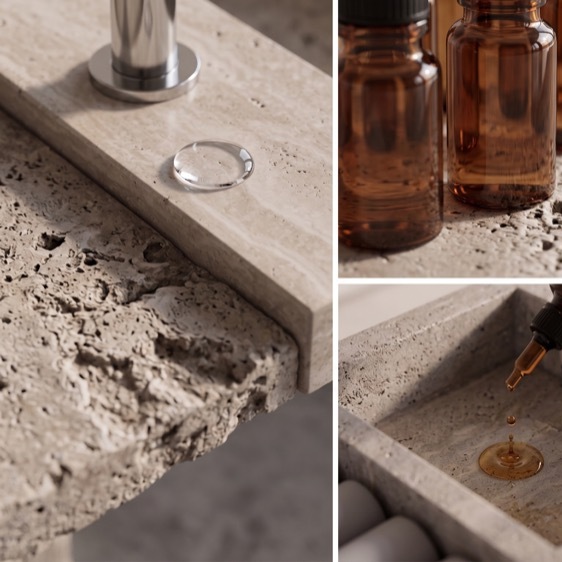
Travertine is more than a surface. It is a mood, a memory of water and time pressed into stone. Long before it becomes a floor or a wall, it forms slowly in the mineral springs of the earth, where mineral-rich water lays down layer upon layer over thousands of years. That patience is written into its body. Run your hand across a travertine slab and you feel the story: the soft ridges, the open pores, the tiny voids where gas once escaped. Nothing about it is uniform, and that is precisely the point.
We are drawn to travertine because it refuses to pretend. A polished, engineered surface aspires to perfection and, in reaching for it, becomes cold and anonymous. Travertine does the opposite. Its porous, sunlit texture carries a quiet warmth that manufactured materials can never imitate. It looks like something that came from the ground, because it did, and that honesty gives a room a kind of moral center.
Light is where travertine truly comes alive. Its surface is never flat to the eye. As morning light rakes across a travertine wall, the pores catch small shadows and the whole plane begins to breathe, shifting from cream to honey to soft amber as the sun moves. A polished stone reflects light and pushes it back at you. Travertine absorbs it, holds it, and returns it slowly, the way warm skin holds the heat of the day.
At Studio Five we use it as an anchor. A single honest material, chosen with conviction, grounds a space and lets everything else fall quiet around it. We lay it underfoot as continuous flooring so the eye travels without interruption. We carry it up a wall to let a room read as one calm gesture. Sometimes we let it become a monolithic element, a kitchen island or a bathroom vanity carved as if from a single block, heavy and certain, the emotional weight of the room made physical.
There is also the matter of how travertine ages, which is really the matter of how we want to live. It is not a material that stays frozen the day it was installed. It takes on the faint patina of use, the softening at a threshold where feet pass, the deepening tone near a window. Rather than fight this, we welcome it. A travertine surface becomes more itself with time, gathering the quiet evidence of a life lived well.
This is why one honest material can carry an entire minimal room. When the surfaces are restrained and the palette is calm, the eye has room to rest, and the single warm material becomes the thing you feel rather than merely see. It grounds the space the way a low, steady note grounds a piece of music. Everything else, the linen, the light, the empty air, is finally free to breathe.
In the end, travertine reminds us that warmth is not something you add to a room. It is something you build into its bones and then let the senses discover, quietly, day after day.